An arrival that cannot be reduced to one date
Telling the story of a food means separating two questions: when it began to be cultivated in a territory, and when it became a regular feature of its meals. A written reference should not be confused with the first crop ever grown there. Documents help us reconstruct evidence, but they cannot always establish an absolute beginning.
Fedearroz acknowledges that exactly how and when rice reached the Western Hemisphere is unknown. Its historical overview records references to plantings around 1580 in the Magdalena valley, near Mariquita in what is now Tolima. The rural catalogue of the Agustín Codazzi Geographic Institute also mentions cultivation in that valley during the 16th century. These references help establish an early presence without turning them into a supposedly exact date of entry into the country. [1][2]
This caution avoids an overly convenient narrative: a ship, a seed, then the cooking we know today. Between a crop's arrival and its establishment lie agricultural work, the circulation of knowledge and many household decisions that were not always recorded.
From the Magdalena valley to other regions
Colombia's rice-growing history gradually expanded its geography. Fedearroz's overview cites the spread of cultivation in municipalities of Tolima and in Campoalegre, Huila. It also dates the beginnings of commercial cultivation in the Llanos to around 1908. This sequence shows that the cereal did not become established everywhere at the same time. [1]
Looking at that map helps explain why there is no single rice-growing landscape. The IGAC catalogue describes the crop's agricultural importance and explains how its fields can be recognised in images through characteristics that change during the growing cycle. A crop seen from the road is only one moment in a process: preparing the land, establishment, growth and harvest. [2]
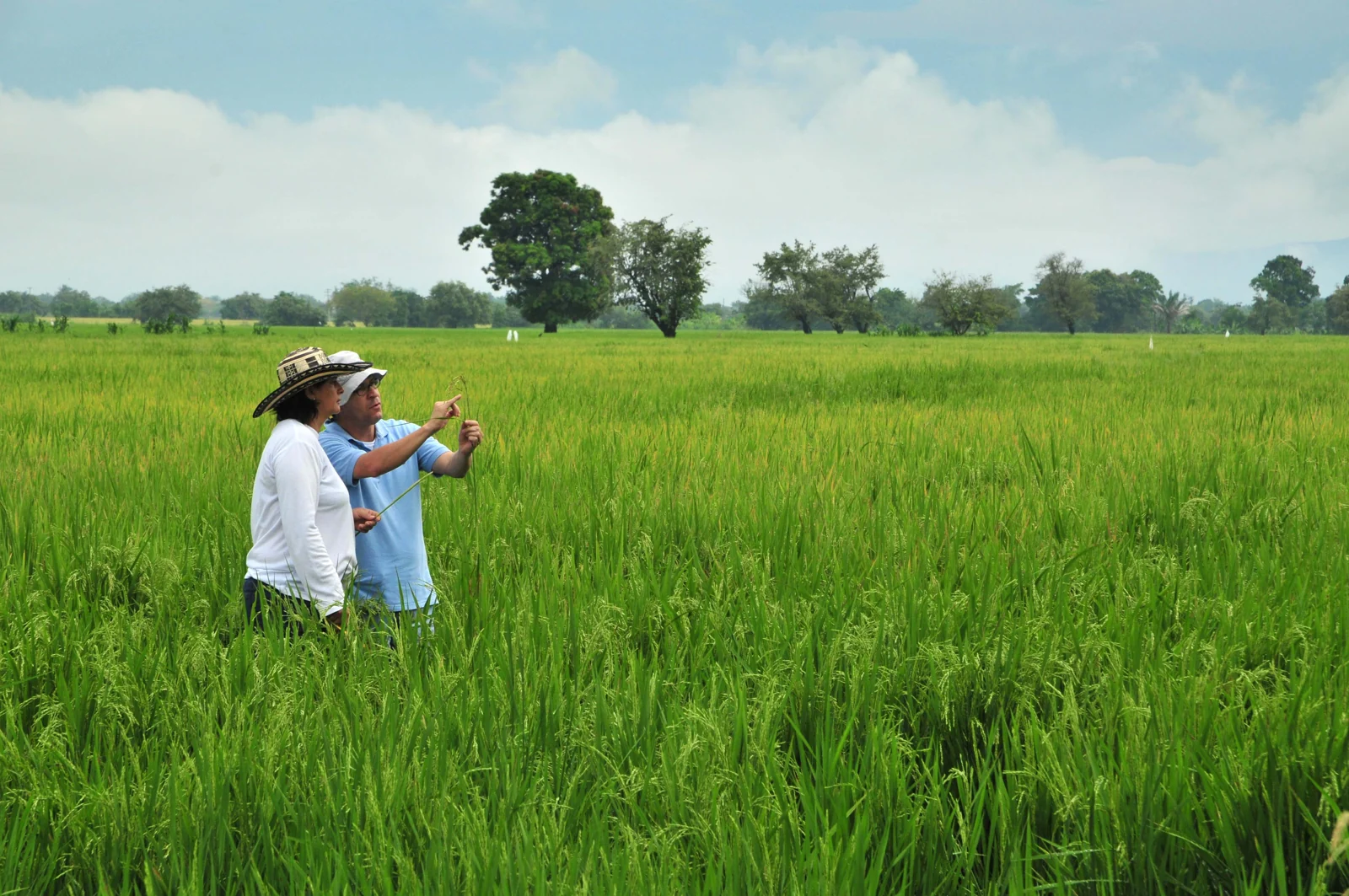
History belongs not only to major dates. It also lives in the knowledge needed to recognise the plant's condition and address its problems. The photograph accompanying this article records field research in Tolima in 2010; it is neither a recreation of the colonial period nor an image of J. Montoro's crops.
Organising to grow, research and sell
In the 20th century, producer organisations added another layer to this story. Fedearroz dates its founding to 1947 and links its beginnings to farmers from municipalities such as Ibagué, Espinal, Saldaña and Venadillo, who sought representation when facing the sector's difficulties. [3]
This development matters because a food does not become familiar simply by growing well. Production, knowledge and commercial distribution need coordination. Institutional history lets us see farmers as protagonists in this process, rather than reducing the countryside to scenery behind a meal.
Today, DANE's National Survey of Mechanised Rice collects information on planted area, production and yields, distinguishing irrigated and mechanised rainfed systems. Its time series provide another way to preserve the crop's history: measuring changes with methods that allow periods and territories to be compared. It is a different perspective from the family recipe, but both concern the same food. [4]
A shared ingredient, many cuisines
At the table, the story becomes plural. Discussing Colombian rice need not mean searching for one representative dish. The Ministry of Culture's traditional cooking inventory organises recipes by region, department, municipality, tradition bearers and uses, among other criteria. This approach recognises that cooking has specific people and places behind it. [5]
Everyday white rice, arroz con pollo and a coconut rice preparation can share an ingredient without playing the same role in a meal. Sometimes they accompany other food; sometimes they bring the entire dish together. This culinary reading helps explain rice's deep roots: familiarity does not require every family to cook it the same way.
It also offers a useful reminder when trying a new recipe. Cooking a Spanish rice dish need not displace Colombian preparations or judge them by the rules of paella. Each dish proposes a texture, a piece of cookware and a way of sharing it. Learning those differences broadens our cooking repertoire.
Understanding origin to choose thoughtfully
The cereal's Colombian history encourages a closer look at any packet: where it comes from, what information it offers, and which dish we want to make. Spanish and Colombian origins do not, by themselves, establish culinary superiority.
On this website we discuss J. Montoro as a specific option for particular preparations. Placing it within a broader rice culture makes the conversation more interesting: behind every casserole are a field, a craft and a cook's decision. Learning about them is another way to enjoy what reaches the table.
Sources consulted
[1] Fedearroz: History of rice.
[2] IGAC: rural geographic objects catalogue, rice entry.
[3] Fedearroz: history of the Federation.
[4] DANE: National Survey of Mechanised Rice.
[5] Ministry of Culture: inventory of traditional Colombian recipes.